
OpenAI Connects ChatGPT to Bank Accounts via Plaid, Betting Users Will Trade Privacy for Financial Advice
A new preview feature links the chatbot to more than 12,000 institutions, surfacing spending habits and portfolio data—but the move is already drawing skepticism about data retention and AI hallucinations.
What matters
- OpenAI announced a preview Plaid integration for ChatGPT on May 15, 2026.
- The feature connects to over 12,000 financial institutions for read-only access to transactions and portfolios.
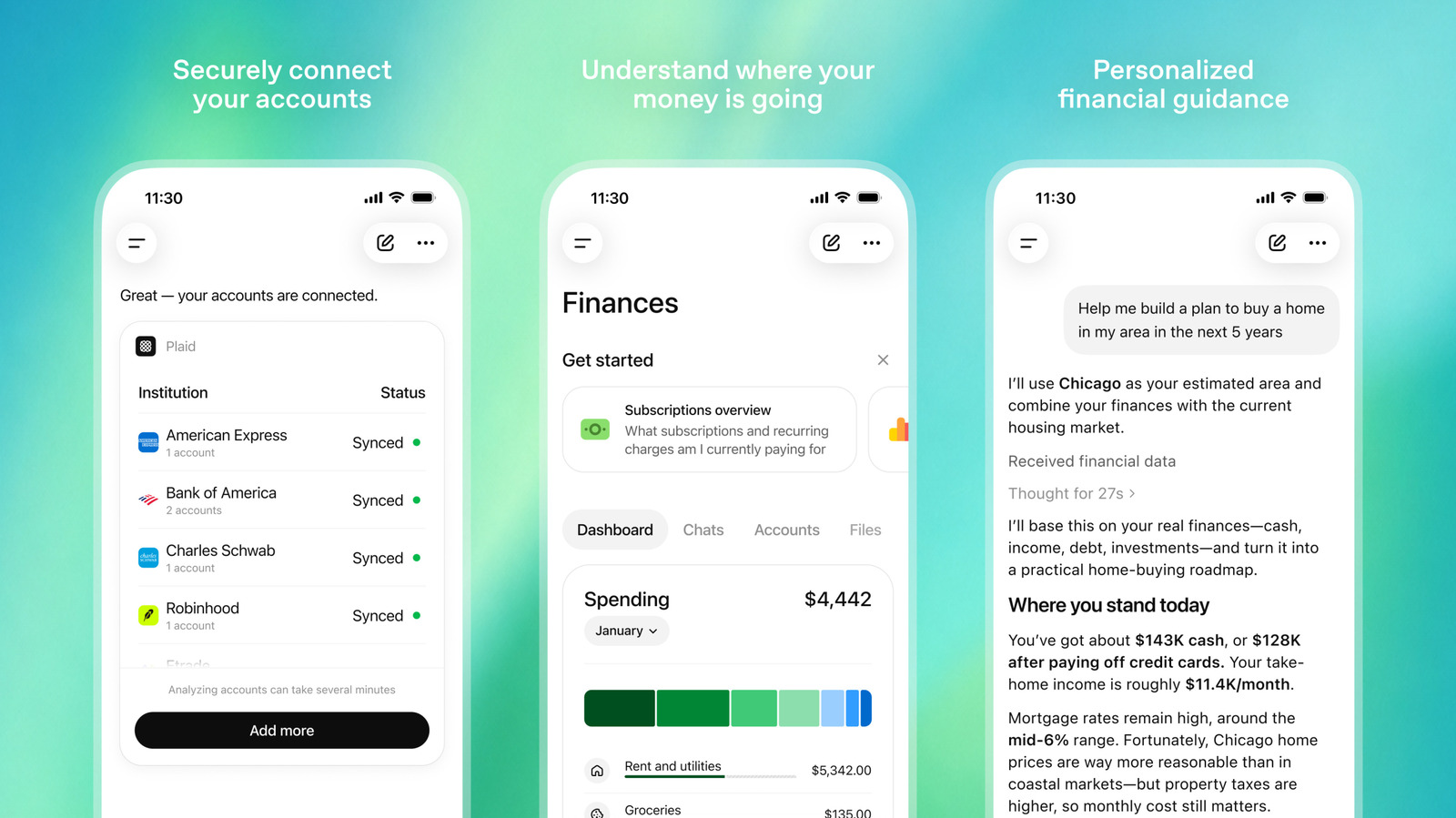
- It surfaces spending dashboards, subscription tracking, and personalized financial advice for ChatGPT Pro subscribers.
- Privacy terms include 30-day data deletion after disconnection and an opt-out for model training, but chat logs may remain.
- Historical analyses suggest AI financial advice carries significant hallucination and bias risks.
What happened
On May 15, 2026, OpenAI launched a preview feature that lets ChatGPT Pro subscribers link their bank and investment accounts to the chatbot through Plaid. The integration supports more than 12,000 institutions—including Schwab, Fidelity, Chase, Robinhood, American Express, and Capital One—and provides read-only access to transaction histories, portfolio balances, and upcoming payments. Once connected, users see a dashboard that breaks down spending habits, active subscriptions, and portfolio performance, and they can ask ChatGPT questions about cash flow or long-term planning.
The launch follows a March leak by engineer Tibor Blaho, who spotted a “Finance” section in development inside ChatGPT, and comes roughly one month after OpenAI acquired the team behind Hiro, a personal-finance startup. For now, the feature is limited to $200-per-month Pro subscribers in the United States on web and iOS, with plans to expand to Plus users.
Why it matters
This is OpenAI’s most aggressive push into a regulated, high-stakes domain: personal finance. By feeding live account data into a conversational interface, the company is asking users to trust a general-purpose large language model with the granular details of their financial lives.
OpenAI says account data will be deleted within 30 days of disconnection and that users can opt out of having their data used to train models. But critics note a critical distinction: chat logs containing financial conversations may persist even after the Plaid link is severed. That gap between synced data and conversation history is already fueling privacy concerns, especially because the feature is opt-in and requires a pricey Pro subscription.
There are also accuracy risks. A 2023 analysis cited by QWE AI Academy found that 35 percent of financial queries posed to AI systems were answered incorrectly, and OpenAI’s own privacy policy acknowledges that generated responses “may not be the most factually accurate.” A 2024 peer-reviewed paper in Heliyon further documented that AI financial output can carry gender, racial, and recency biases. When the advice is grounded in a user’s actual bank balance and transaction history, the cost of a hallucination becomes concrete rather than theoretical.
Public reaction
Discussion on Reddit’s r/technology was sharply skeptical. A post about the feature garnered 381 upvotes and more than 120 comments, with the top-voted reply calling the integration “malware” and others accusing OpenAI of harvesting spending habits to fuel targeted advertising. Several users questioned whether AI assistance was even necessary for routine personal budgeting. The dominant sentiment was not excitement about convenience but alarm over data monetization and security.
What to watch
Regulators have not yet weighed in, but financial advice is a heavily supervised industry. The key questions are whether OpenAI will face scrutiny for offering personalized guidance tied to real account data, what liability it assumes if the model hallucinates tax or investment advice, and whether aggregated spending patterns could be monetized beyond the subscription fee. The expansion from Pro to Plus users will also test whether mainstream consumers are willing to make the same privacy trade-off. Meanwhile, competitors in both fintech and AI will be watching closely to see if bank-account linking becomes a standard feature for generalist chatbots or remains a cautionary tale.
Sources
Public reaction
Reddit users reacted with strong skepticism, with the top discussion on r/technology framing the feature as a pretext for harvesting spending data for ads. Many commenters dismissed the utility of AI-driven personal finance help and raised alarms about security, with some likening the integration to malware.
Signals
- Widespread privacy alarm over data retention and ad targeting
- Skepticism about the practical value of AI financial advice
- Suspicion that spending data will be monetized beyond stated use
- Confusion over distinction between account data deletion and chat log persistence
Open questions
- Will OpenAI monetize aggregated spending patterns beyond direct subscription revenue?
- How will regulators classify AI-generated financial advice delivered with real account data?
- What liability does OpenAI face if the model hallucinates investment or tax guidance based on live financial data?
What to do next
Developers
Audit any financial data integrations for read-only scope and ensure clear audit trails; expect heightened scrutiny on Plaid-like connections in your own apps.
OpenAI’s move normalizes bank-account linking inside AI interfaces, which will raise user expectations—and security standards—for all fintech-connected products.
Founders
Treat this as a signal that AI incumbents are vertically integrating into fintech; niche personal-finance AI tools now face direct competition from generalist platforms.
A well-capitalized generalist with distribution can enter personal finance quickly, compressing the addressable market for standalone budgeting or advisory startups.
PMs
If building data-connected features, prioritize transparent deletion policies and in-product explanations of what persists (chat logs vs. synced data) to preempt user trust erosion.
Early Reddit sentiment shows that users fixate on data retention; clear controls can differentiate your product and reduce churn.
Investors
Monitor whether this expands ChatGPT Pro retention or triggers regulatory review that could slow AI-financial product convergence.
Financial advice is a heavily regulated domain; a compliance misstep by a market leader could chill venture funding for adjacent startups.
Operators
Review your organization's AI usage policies; connecting corporate bank accounts to consumer AI tools may violate internal compliance even if the feature is read-only.
Read-only access still exposes transaction history, which may breach company data-handling or banking covenants.
How to test
- 1Navigate to the new financial connections settings inside ChatGPT
- 2Select your institution from the Plaid link flow and authenticate with your bank credentials
- 3Review the read-only permissions before confirming
- 4Explore the generated dashboard for spending categories, subscriptions, and portfolio summaries
- 5Test the advice feature by asking a specific budgeting or cash-flow question
- 6Disconnect the account and verify the 30-day deletion timeline in settings
- 7Check whether model training opt-out is enabled separately from data deletion
Caveats
- The feature is in preview and may have limited availability
- AI-generated financial advice has documented hallucination risks; do not act on high-stakes guidance without human verification
- Chat logs may retain records of financial conversations even after Plaid disconnection
- Supported institution lists and data granularity may vary